
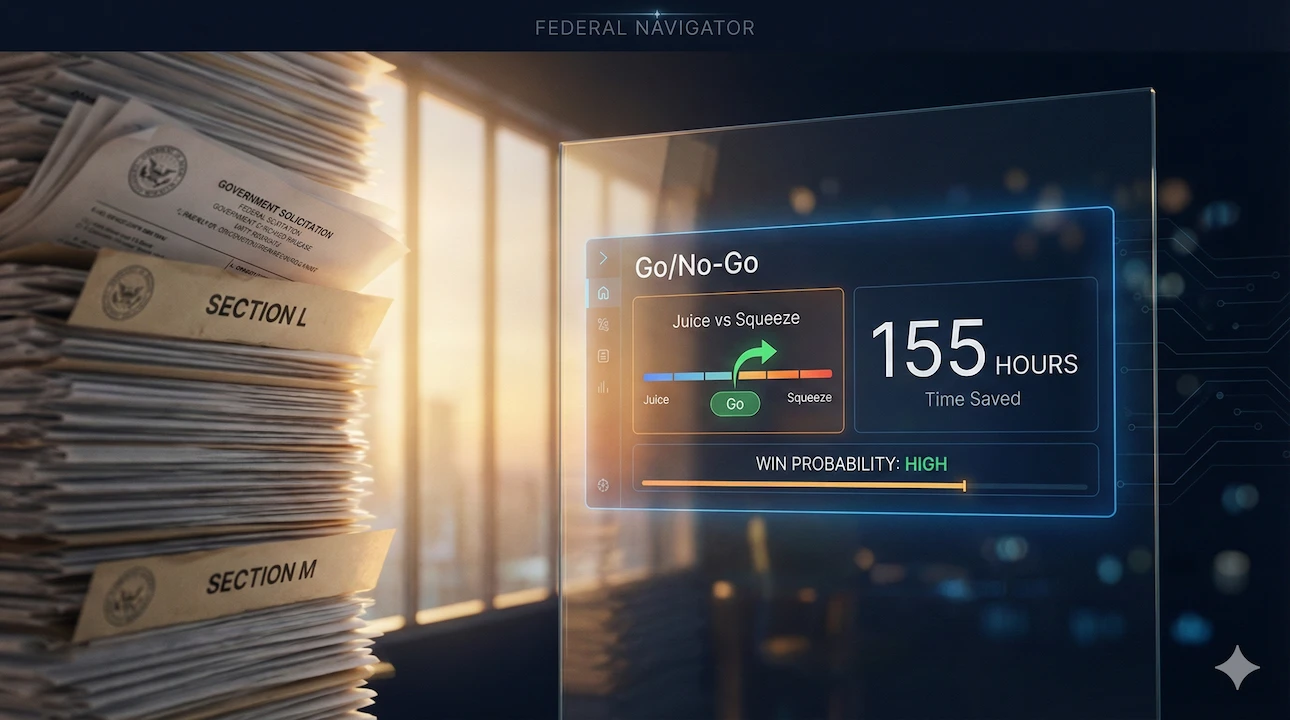
The quiet truth: most “federal proposal capture” guides assume you have a capture manager and a year. You do not. You are the founder (or one of two BD people), the alert just hit, and the partner email says this one is a “must pursue.” The moves that matter are the few that change which bids get people, not a binder of process theater.
This guide is the Decide job in capture clothing: qualify early, use public leverage when it is real, freeze bid/no-bid with receipts, then run Outside-In when any package (RFI, draft RFP, or final) lands. Write still belongs to your team. Find still belongs to SAM and your inbox.
TL;DR
Fill a one-page Pursuit Napkin (qualify, public intel, teaming gap, RFI yes/no, bid/no-bid freeze) before anyone opens the SOW in depth. When paper drops, hand off to hard gates and cost-to-bid math. Use AI to draft the napkin; you own the Go/No-Go on SAM and the PDFs.
Tuesday at 4:30: what would you do?
A SAM.gov alert lands. Partner email from this morning calls the same notice a “great capture.” Contract value looks healthy. You have ten minutes between calls. There is no capture shop, no color-team calendar, and no one else to own the next hour of B&P.
You have not decided whether this pursuit deserves any more of your week.
What would you do?
Option A: Stand up formal capture theater
Draft a multi-tab capture plan, schedule “pink team” language, and build a stakeholder map for a relationship you do not have. Feel productive. Burn the week before the RFP even drops.
Option B: Ignore everything until the final RFP
Skip the RFI. Skip intel. When the package hits, open Section C first, staff a kickoff, and discover hard gates and LOE killers after people are already assigned.
Option C: Fill a Pursuit Napkin now
In one sitting, qualify fit and capacity, capture public intel you can cite, decide teaming and RFI leverage, freeze bid/no-bid. When any package lands, Outside-In before the SOW.
The correction: Option C wins. Option A fails because process without leverage is expensive cosplay for a 15-person shop. Option B is the most common small-team trap: excitement later, showstoppers later, sunk hours third. For Sam, “winning” starts as better shots and fewer doomed bids.
The Pursuit Napkin (what good early capture looks like)
Experienced small teams do not need a 40-factor scorecard. They need a short, versioned napkin that answers five questions before Write starts: Can we even do this? What public facts change our odds? Who must we team with? Is an RFI worth the hours? Are we Go, Watch, or No-Bid until paper drops?
That is federal proposal capture when you wear every hat. The industry habits still matter (qualify hard, gather citeable intel, team to fill gaps, engage public market research when leverage exists, freeze a decision). You just skip the binder.
Pain you avoid when you do this first: partner-driven “must bid” pressure with no receipts, RFI responses that invent intimacy you cannot prove, and Friday discovery that clearance, geography, or past performance rules already killed the shot.
Workflow at a glance
- Qualify before you crush on: fit, capacity, clearance/geo/cert realities you already know.
- Public intel only: incumbent, awards, agency docs you can cite (no invented “customer intimacy”).
- Teaming as gap-fill: need / bring / walk-away, not logo collecting.
- RFI / Sources Sought: respond only when the ask can change evaluation or prove capability; otherwise skip.
- Bid/no-bid freeze: Go, Watch, or No-Bid with a one-line reason and a review date.
- When paper drops: Outside-In hard gates, then cost-to-bid LOE (do not re-open the SOW first).
Habit 1: Qualify before you crush on
Write three lines: capability fit, people available in the response window, and hard realities (clearance, place of performance, certifications you hold at submission). If any line is a hard no, stop. That is capture doing its job.
Habit 2: Public intel only
Pull what is citeable: SAM history, USASpending or FPDS awards, incumbent name if public, agency strategy docs. If you cannot point to a source, it does not go on the napkin. Fantasy intel is how small teams talk themselves into Write.
Habit 3: Teaming as gap-fill, not logos
List the gap you cannot fill alone, what a partner must bring, and your walk-away if the partner wants prime. Logos without a gap are vanity. A single missing Key Personnel or past performance lane is often the real gate.
Habit 4: RFI / Sources Sought only when it buys leverage
Public market research is worth hours when you can clarify requirements, show relevant capability, or learn evaluation direction. It is not worth hours when the notice is a checkbox, you have nothing distinct to say, or you would be inventing “insights” the agency did not ask for. Stay on public channels only.
Habit 5: Bid/no-bid freeze
Freeze Go / Watch / No-Bid with a reason Sam can defend to a partner in one sentence. Set a review date (for example, draft RFP drop or RFI due date). Without a freeze, every alert stays “maybe” forever and B&P leaks.
Habit 6: When paper drops, hand off to Decide depth
An RFI package, draft RFP, or final RFP is a Decide event. Run Outside-In hard gates before the SOW. Then size effort with cost-to-bid / Section L and M workload math. If influence risk is the worry, use the wired RFP red-flag screen. Do not re-teach those essays here; link and move.
Filled Pursuit Napkin (sample)
One realistic vignette for a fake agency IT services recompete (your napkin stays this short):
| Field | Entry |
|---|---|
| Qualify | Core work matches our cloud ops lane; two engineers free in next 6 weeks; Secret clearance held; CONUS only (notice is CONUS). |
| Public intel | Incumbent Acme IT (FPDS FY25 awards); Sources Sought posted; no draft RFP yet. Cite: SAM notice ID + FPDS award IDs. |
| Teaming | Gap: agency-specific PP with CPARS in last 3 years. Need sub with relevant PP; we bring cleared cloud team. Walk-away if partner demands 60%+ and our PP. |
| RFI? | Yes. Agency asked for similar past performance examples and transition approach. Due 2026-09-12 on SAM. Skip solution essay beyond asked questions. |
| Freeze | Watch until draft RFP. Reason: fit ok, PP gap open, no L/M yet. Review on draft drop or if RFI answers reveal wired language. |
AI to the rescue: techniques and prompt starters
General-purpose LLMs are useful as faster interns for napkin drafts and RFI skeletons. They do not replace SAM dates or the PDF. They do not create customer relationships you do not have.
Techniques that hold up:
- Public sources only: paste notice text, RFI questions, or award excerpts. Ban “assume we know the PM.”
- Citation discipline: every napkin claim needs a source line. If the model cannot cite, mark NEEDS_REVIEW.
- Draft is not final: treat draft RFP language as provisional; re-run gates when the final package lands.
- Skeptic pass: ask what would make this a No-Bid for a 15-person shop.
Prompt starter 1: Pursuit Napkin from a SAM notice
Prompt starter 2: public intel checklist
Prompt starter 3: RFI reply skeleton
Prompt starter 4: bid/no-bid freeze helper
Common AI failure modes (early capture): invented customer intimacy, fake incumbents, treating draft RFP as final, and confident RFI essays that overclaim. Fix with narrower pastes, forced cites, and human verification on SAM and PDFs.
Verification (non-negotiable)
Before anyone treats the napkin as “done,” a human confirms on SAM.gov (notice type, response date, timezone, active status) and on the source PDFs for any RFI, draft, or final package. Public solicitations only. Do not upload CUI, ITAR, or Classified. AI proposes; Sam owns Go/No-Go.
Why even great napkins are not the whole system
The workflow above works until a draft RFP ZIP lands with five volumes, two amendments, and a partner pushing kickoff the same afternoon. Consistency breaks under package size, amendment churn, and handoffs. That is not a skill gap. It is an orchestration gap on the Decide step.
Unique mechanism
askaGOAT runs the same Decide discipline across the whole package
When an RFI package, draft RFP, or final solicitation is in hand, upload the public package. askaGOAT applies structured triage across volumes and amendments and surfaces a Hoofnote-style brief so hard gates and workload signals do not depend on one chat thread.

Hoofnote: bid killers and dates on one page before you sink days into the SOW.
Triage Your Next RFP FreeNo credit card necessary. Public solicitations only.
Next in this series
Early capture freezes the shot. Hard gates and cost-to-bid LOE decide whether Write is worth staffing. For finding the next alert, use SAM.gov saved search setup.
Do not skip verification because the napkin “looks decisive.” The expensive failures are almost always one amendment or one mandatory deep.
Frequently asked questions
What is federal proposal capture for a small team?
It is the short set of Decide habits before Write: qualify, gather public intel, team to fill real gaps, use RFI leverage when it matters, and freeze bid/no-bid. It is not a year-long capture department.
Should every SAM alert get a full capture plan?
No. Most alerts get a Pursuit Napkin or a fast No-Bid. Full process theater burns B&P that should wait for pursuits with real leverage and a clean hard-gate path.
When should I respond to an RFI or Sources Sought?
When the questions let you clarify requirements or show relevant capability with evidence you actually have. Skip when you would invent intimacy or write a free proposal.
How does askaGOAT fit after the Pursuit Napkin?
The napkin decides whether a package deserves triage time. askaGOAT runs Outside-In style checks across the uploaded public package so you verify citations instead of re-prompting every volume. It does not write your RFI or proposal.
Automate RFP triage, not judgment
askaGOAT is built for small GovCon teams that need Decide discipline on every pursuit. Start a free trial and turn the same hard-gate logic into repeatable output when the package lands.
Start Your Free TrialNo credit card necessary.