
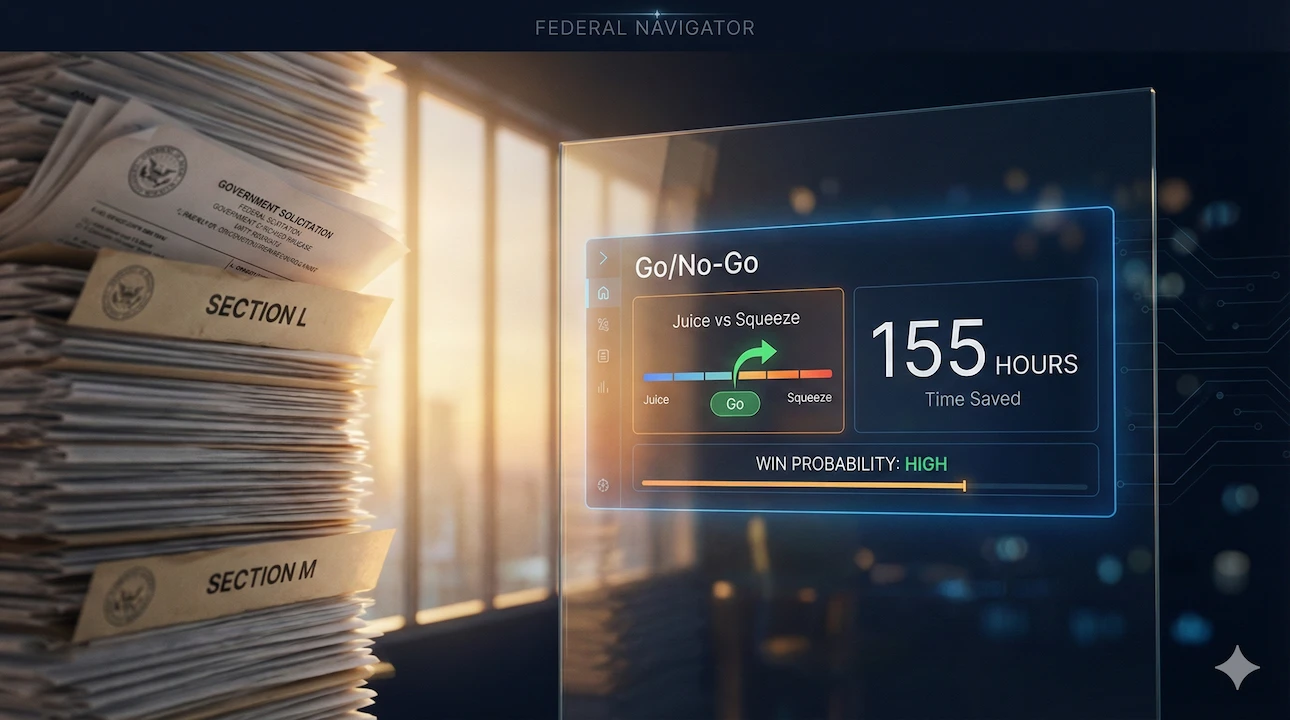
The quiet truth: attractive scope can hide a proposal that costs more to write than the award is worth. Before you ask "Can we win?", ask "Does the Level of Effort (LOE) to produce a compliant submission justify this opportunity?" The fastest answer lives in Sections L and M, not the SOW.
When small BD teams reverse that order, B&P gets burned on bids that were never submission-ready for a shop your size.
TL;DR
Pull volume counts, Key Personnel load, and PPQ vs CPARS from Sections L and M into a one-page ROM worksheet. Run effort-vs-reward math before anyone opens Section C. Verify every count on the source PDF. AI can draft the worksheet; you own the Go/No-Go.
Tuesday at 4:30: what would you do?
A SAM.gov alert hits your inbox. Partner email from this morning says the same RFP is a "great fit." You have ten minutes between calls. The SOW reads like work you already do. Contract value looks healthy. You can already picture telling the team this one is a go.
You have not opened Section L yet.
What would you do?
Option A: Size the bid by dollar value
Big number means worth pursuing. Small Task Order means "quick response." Skip LOE math and start outlining technical themes.
Option B: Build a proposal ROM from L and M first
Count volumes, page limits, Key Personnel resumes, and past performance rules. Estimate hours. Decide Go/No-Go on effort-vs-reward before deep SOW reading.
Option C: Skim the SOW and commit
Send leadership "this one looks good," hold a kickoff, and "come back to instructions later." Reality shows up when Section L demands five volumes, Letters of Commitment, and PPQs on a short fuse.
The correction: Option B wins. Option A fails because contract value is a terrible proxy for proposal burden. Option C is the most common small-team trap: excitement first, showstoppers second, sunk hours third.
Anyone who has lived through a few fiscal year-ends knows the LOE scenarios by heart:
- Scenario A: A large IDIQ vehicle can be surprisingly light, sometimes a Pass/Fail technical volume and a price sheet.
- Scenario B: A small agency Task Order can demand a full technical approach, management plan, transition strategy, and a stack of resumes.
Dollar value tells you almost nothing about proposal burden. "Small contract = small effort" quietly destroys Bid & Proposal budgets for founder-led BD.
Sections L and M: where the real cost of bidding lives
Section L tells you how to respond. Section M tells you how you will be evaluated. Between the two, you can infer far more about LOE than the SOW ever reveals. That is why Sections L and M beat the SOW for hard-gate triage.
You are not hunting clever win themes yet. You are extracting three effort drivers that decide whether this bid is worth your week.
Effort driver 1: Volume count and structure
How many separate volumes does the government want?
- Standard: Three volumes (Technical, Management/Past Perf, Price).
- Danger zone: Four or more volumes. Effort climbs fast.
Each volume needs structure, ownership, reviews, and compliance checks. For a small team, five volumes on a short timeline is not ambitious. It is a showstopper disguised as ambition. Section M often makes this worse by weighting standalone volumes, which means more writing, not just more files.
Effort driver 2: Key Personnel load
Key Personnel requirements are the quiet budget killer for small shops.
- Manageable: One required resume (usually a PM). Recycle a bio, grab a Letter of Commitment, move on.
- Unmanageable: Multiple Key Personnel. Now you are running a mini-staffing exercise, not just writing.
The math: Tailoring federal resumes is not copy-paste. Mapping experience to the PWS, rewriting narratives, and chasing signatures takes 2 to 4 hours per resume. Five Key Personnel means roughly 20 hours before a single page of technical content.
Effort driver 3: Past performance (PPQ vs CPARS)
- The trap: Mapping each project to specific PWS elements often costs 4 to 6 hours per citation.
- The PPQ risk: A Past Performance Questionnaire means coordinating a government POC signature on their schedule, not yours.
- The shortcut: If the solicitation accepts CPARS instead of PPQs, you cut days off the timeline.
Spot this early: PPQs mean schedule risk; CPARS mean speed. That detail alone can flip a Go to a No-Bid for a two-person BD bench.
Workflow at a glance
- Open Sections L and M (plus amendments) before Section C.
- Count volumes, page limits, Key Personnel, and PPQ vs CPARS rules.
- Fill the ROM worksheet with hours (not vibes).
- Run Juice vs Squeeze: contract value and fit vs hours and disruption.
- Verify every count on the source PDF.
- Decide Go/No-Go before anyone starts writing.
Manual ROM worksheet (no upload required)
You do not need precision for a defensible Bid/No-Bid. You need a Rough Order of Magnitude you can defend in a hallway conversation. Use this table on a notepad or spreadsheet. Rule of thumb many small teams use: 1 technical page ≈ 4 hours (drafting + SME input + review + formatting).
| Cost driver | Count from L/M | Hours each | Est. hours | Notes / cite |
|---|---|---|---|---|
| Volumes × page limits | ___ vols / ___ pages | ~4 hrs/page | ___ | L cite: |
| Key Personnel resumes | ___ KPs | 2–4 hrs | ___ | LOC required? Y/N |
| Past performance | ___ citations | 4–6 hrs (or CPARS pull) | ___ | PPQ or CPARS? |
| Example: Agency TO (filled) | 4 vols / 30 tech pages; 5 KPs; 3 PPQs | 4 / 4 / 5 | 155 hrs | 120 + 20 + 15; L.2.1, L.3, M.2 |
| Your total | ___ | Capacity without breaking the team? |
In the filled example, 30 technical pages, five resumes, and three PPQ-driven past performances land near 155 hours. If you cannot absorb that without wrecking delivery work, it is a No-Bid, not a character flaw.
AI to the rescue: draft the ROM faster
Paste Section L (and the past performance / Key Personnel clauses) into a general-purpose model. Treat the output as a draft worksheet, not a decision.
Prompt starter 1: volume and page LOE
Prompt starter 2: Key Personnel and PPQ vs CPARS
Common AI failure modes: invented page limits, missed "see Attachment," wrong KP counts, and assuming CPARS when the text requires PPQs. Forced cites plus the verification step below fix most of that.
Verification (non-negotiable)
Before you call the ROM "done," open the source solicitation PDF (final amendment set) and confirm:
- Volume count and page limits match Section L (and any amendment overrides).
- Key Personnel roles, resume format, and Letter of Commitment rules match the text.
- Past performance rules: PPQ forms, CPARS allowed, citation count, and relevance matrix requirements.
AI proposes hours. You own the Go/No-Go. Re-run verification after every amendment.
The Juice vs Squeeze test
- The Juice: Contract value, strategic fit, realistic PWin for a shop your size.
- The Squeeze: Proposal hours, disruption to delivery staff, burnout risk.
A pursuit only makes sense when the return justifies the squeeze. Most teams miss this step because Sections L and M are dense. People skim the SOW, get excited, and commit. The burden shows up days later, after the B&P clock is already running.
Why a worksheet still breaks under full packages
The method above works until Mod 02 rewrites page limits, a partner forwards a second "must bid," and your only SME is on a client call all week. Consistency breaks under package size, amendment churn, and handoffs. That is an orchestration gap, not a skills gap.
Unique mechanism
Let askaGOAT run the proposal ROM before you commit
Upload the solicitation. Get page counts, volume structure, Key Personnel load, and bid killers in a Hoofnote-style triage so effort-vs-reward does not depend on one frantic skim of Section L.
Try it free on your next RFP →No credit card needed.
A better pre-read habit
On your next set of SAM.gov leads, before anyone gets excited:
- Find and filter opportunities with a proven SAM.gov search strategy.
- Before the RFP drops, run early pursuit habits with a Pursuit Napkin.
- Fill the ROM worksheet from L and M (or let askaGOAT draft the workload summary).
- Verify counts on the PDF.
- Run Juice vs Squeeze.
- Decide.
If the answer is no, you saved real money and real sanity. That is a smart No-Bid.
Do not skip verification because the hours "look about right." The expensive misses are almost always one amendment or one PPQ deep.
Estimate federal proposal LOE before you bid
Run this before writing starts: estimate proposal workload and showstopper risk from the full RFP package. Upload a federal solicitation to askaGOAT and get a proposal ROM in under 60 seconds.
Start Your Free TrialNo credit card necessary.