
The expensive instinct: a partner forwards a "good fit" RFP at 4:30. You open Section C, get excited, and pull an engineer into a scoping call. That is how small teams burn days on bids they were never eligible to submit.
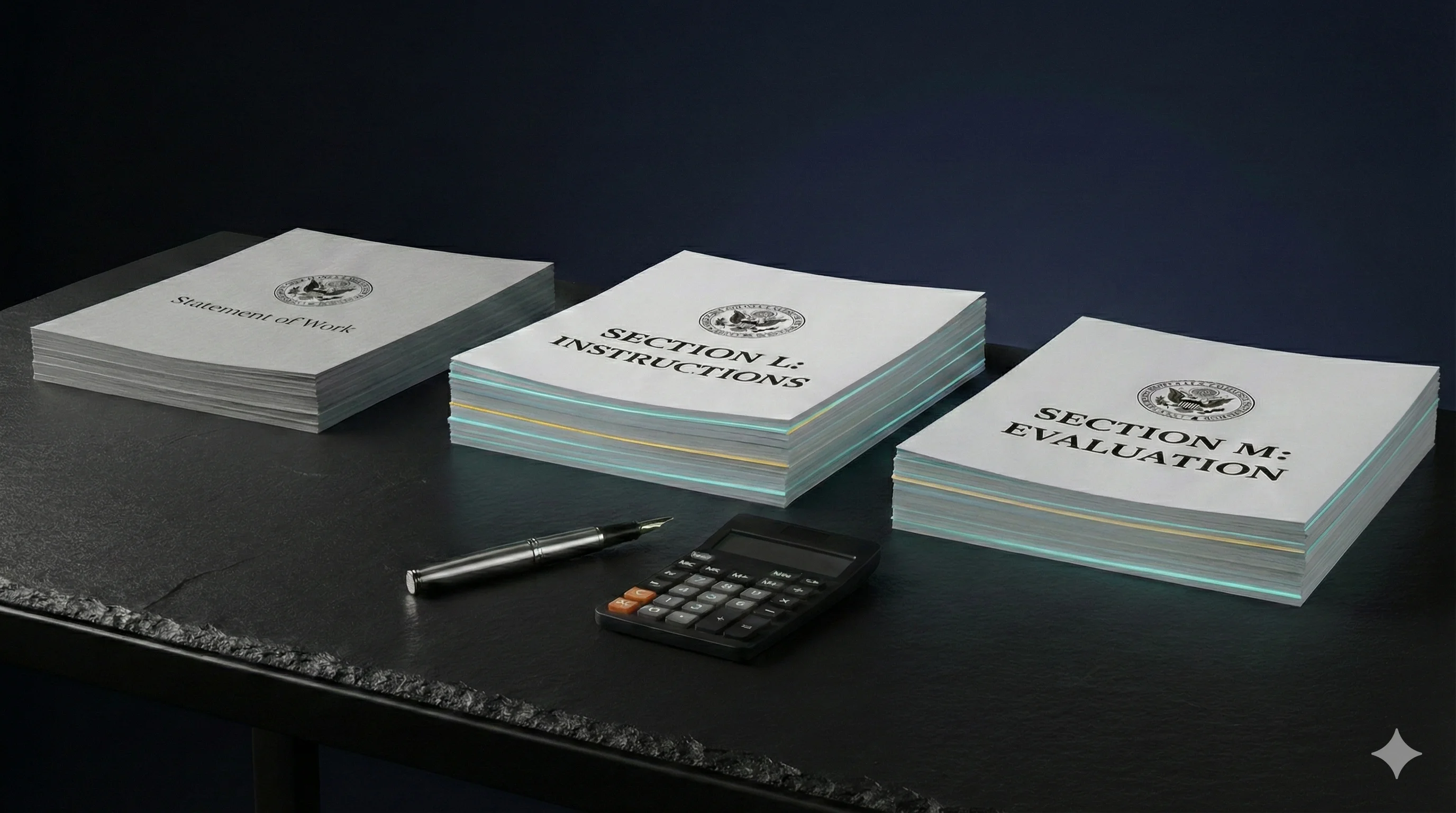
In federal RFPs, the fastest disqualifiers have nothing to do with the SOW. Hard gates live in Sections L, M, and H. This page is Gate 1 only: can you bid at all? It is not a full weighted go/no-go scorecard.
TL;DR
Run Outside-In before the SOW. Log every hard gate in a shall → cite → owner mini matrix. Clear the five disqualifier patterns below (or no-bid with receipts). Use AI to draft candidate rows; verify every cite on the PDF and amendments.
For depth on one slice at a time (submission matrix, evaluation map, Section H triage), use the AI RFP Review series. Start with Section L when instructions are the unknown.
4:30 PM: what would you do?
A partner forwards a solicitation that "looks like your sweet spot." You have ten minutes before your next call. No proposal shop. No capture deck. Just you and a ZIP of PDFs.
What do you do first?
Option A: Open the SOW
Skim Section C for keywords. Text a teammate: "Can we do this work?" Momentum builds before eligibility is known.
Option B: Outside-In hard gates
Scan Sections L, M, and H (plus amendments) for clearance, set-aside, certs, portals, and special staffing rules. Log each gate with a source cite before any SOW deep-read.
Option C: Gut no-bid
The package is huge. You pass on feel without documenting why. Tomorrow you cannot explain the decision, and a similar alert gets the same fuzzy treatment.
The correction: Option B wins. Option A creates emotional investment in a pursuit you may not be allowed to submit. Option C skips the receipts that protect your time next week. Gate 1 is binary eligibility and submission showstoppers, not a multi-factor Pwin workshop.
The Outside-In hard-gate workflow
Experienced small-team BD treats L, M, and H as a control pass, not a warm-up. The artifact is a short eligibility matrix you can defend in one screen share.
Workflow at a glance
- Freeze the set: base solicitation + attachments + every amendment.
- Scan L → M → H for hard gates (clearance, set-aside, certs, registrations, Section H staffing/citizenship).
- Log each gate: Requirement | Pass/Fail/Unknown | Source cite | Owner | Evidence needed.
- Re-run the matrix when an amendment drops (later mod wins unless the solicitation says otherwise).
- Only after gates clear (or you accept a priced risk with eyes open) invest in Section C.
Filled example: shall → cite → owner
Fake but realistic rows from a small-business IT services RFP. Your table will look like this after ten focused minutes:
| Requirement | Status | Cite | Owner |
|---|---|---|---|
| Active Secret FCL at submission | FAIL | L.5.2; Mod 01 p.3 | Sam (BD) |
| Total small business set-aside; NAICS 541512 | PASS | SF 1449 block 10; L.3 | Sam |
| CMMC Level 2 final at proposal due date | UNKNOWN | M.2.1 pass/fail | Ops lead |
What good evidence looks like: PASS means you can point to a certificate, SAM status, or signed JV agreement dated before submission. UNKNOWN means stop and confirm before any SOW workshop. FAIL means no-bid (or restructure with a partner who clears the gate) before you burn engineering time.
The five hard-gate disqualifiers
Common patterns where agencies eliminate bidders before technical scoring. Always verify the exact language in your solicitation.
1. Facility Clearance Level
Evidence: current FCL letter matching the level and agency path named in L/H. "In-process" rarely counts. Cleared people on staff are not a company FCL. IDIQ award without FCL can still require one on task orders.
2. Set-Aside Eligibility
Evidence: correct socioeconomic status under the named NAICS size standard, plus a compliant JV or Mentor-Protégé structure if you are bidding as a team. Misread size standards are instant no-bids.
3. Corporate Certifications or Maturity Levels
Evidence: CMMC, ISO, CMMI (or similar) held at submission when L/M say so. A plan to obtain later is not a pass on a pass/fail gate.
4. Mandatory Registrations or Systems
Evidence: active SAM, current Reps & Certs, and login access to the named portal. Finding a registration issue on due date is usually a lockout, not a fixable typo.
5. Section H Special Requirements
Evidence: you can staff and price key-person, citizenship, on-site, or replacement rules as written. Attractive scope with impossible H clauses is still a no-bid for a 15-person shop.
Where gates hide
The four places to check first
- Section L: how to submit and what is mandatory before scoring.
- Section M: pass/fail evaluation gates.
- Section H: special security, staffing, or agency clauses.
- Amendments: late changes after you already "decided."
AI to the rescue: Gate-1 prompt starters
Use a general-purpose model as a fast intern. It drafts candidate matrix rows. You still own the PDF.
Prompt 1: hard-gate extract
Prompt 2: amendment override check
Prompt 3: evidence checklist
Common AI failure modes: inventing CMMC levels, treating "desired" as "required," missing "at time of proposal submission," and ignoring Mod language that quietly added a portal. Fix with forced cites and human PDF verification.
Verification (non-negotiable)
Before you call Gate 1 done, open the source PDFs (final amendment set) and confirm: every matrix cite, due date and timezone, set-aside and NAICS text, and whether "in process" clearances or certs are allowed. AI proposes; you sign off. Re-run verification after every amendment.
Why manual Gate 1 still breaks
The workflow works until three alerts land the same week, Mod 02 drops overnight, and you reuse last month's assumptions. Consistency under volume is an orchestration problem, not a willpower problem.
Unique mechanism
askaGOAT runs Outside-In across the whole package
Upload the RFP. Get a Hoofnote-style triage that flags Section L and M dealbreakers in minutes so you protect BD time before you open the SOW.

Hoofnote: hard gates on one page before you invest a day in Section C.
Triage Your Next RFP FreeNo credit card necessary.
Start from the outside in. Every hour on a no-go RFP is an hour stolen from a bid you can actually submit.
Next steps
Turn this Gate-1 pass into a repeatable eligibility checklist you run on every alert. When instructions alone are the risk, go deep on Section L.
Do not skip verification because the matrix "looks complete." The expensive misses are almost always one amendment deep.
Spot hard gates before you burn a day
You can run Outside-In by hand. When volume and amendments make consistency break, upload a solicitation to askaGOAT and get mandatory checkpoints before you invest in the SOW.
Start Your Free TrialNo credit card necessary.