
SAM.gov search set up wrong costs you time either way: empty results or a flood of irrelevant notices. In eight minutes, set up a saved search and daily emails so only relevant contract notices reach you.
Whether you pay for a paid alert tool or use free SAM.gov with no saved search, discovery breaks the same way: too many irrelevant notices or hardly any matches. By law, opportunities post to SAM.gov. Many paid alert tools repackage that same public feed. You need SAM.gov set up correctly so only relevant contract notices reach your inbox.
How to Search SAM.gov for Contract Opportunities (Step by Step)
The 8-Minute Setup:
- Find your absolute highest probability NAICS codes.
- Filter out the junk using advanced "NOT" operators.
- Set up a permanent tripwire to email you the best daily leads.
- Navigate to the SAM.gov Contract Opportunities search
- Open the Search Editor and scope to Contract Opportunities
- Reverse-engineer award notices to find your NAICS Sweet Spot
- Confirm your NAICS codes against real awarded contracts
- Build your automated search with proven filters
- Save the search so it persists
- Turn on daily email alerts
Back to Basics (of SAM.gov search)
Navigate to the Contract Opportunities search and we'll walk through everything you need to set it up for automation.
Remember, the SAM.gov search matches text across all text fields in an Opportunity. We'll also show you how to exclude keywords with the NOT operator to filter out poor contracts for bid.
1 Start at the SAM.gov Contract Opportunities search
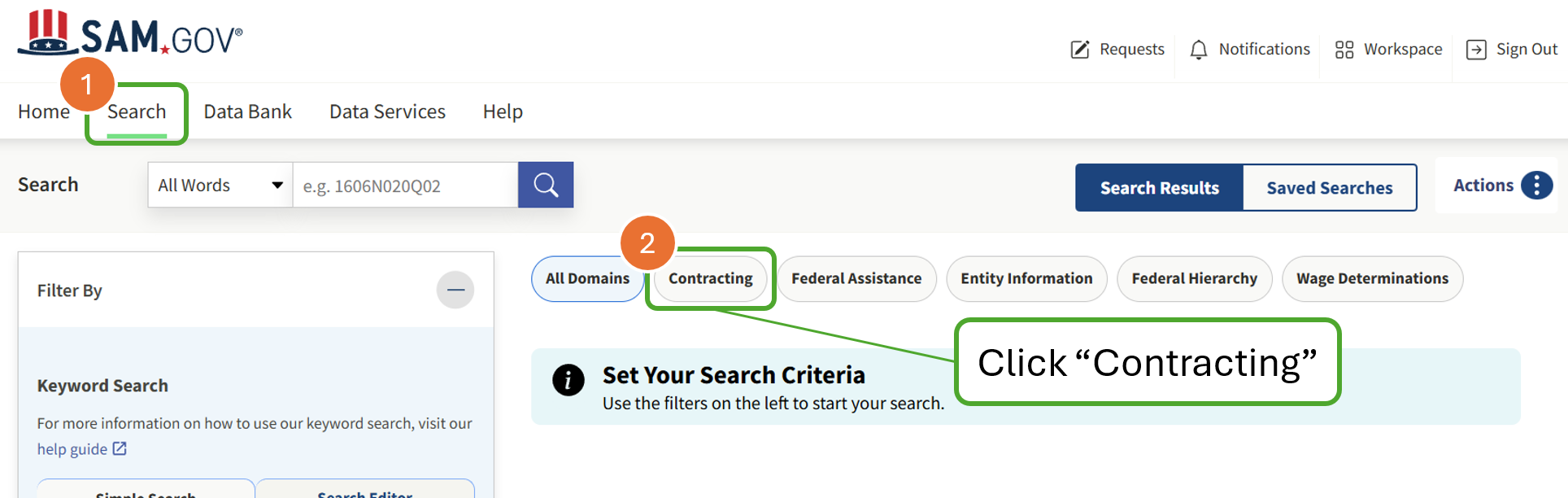
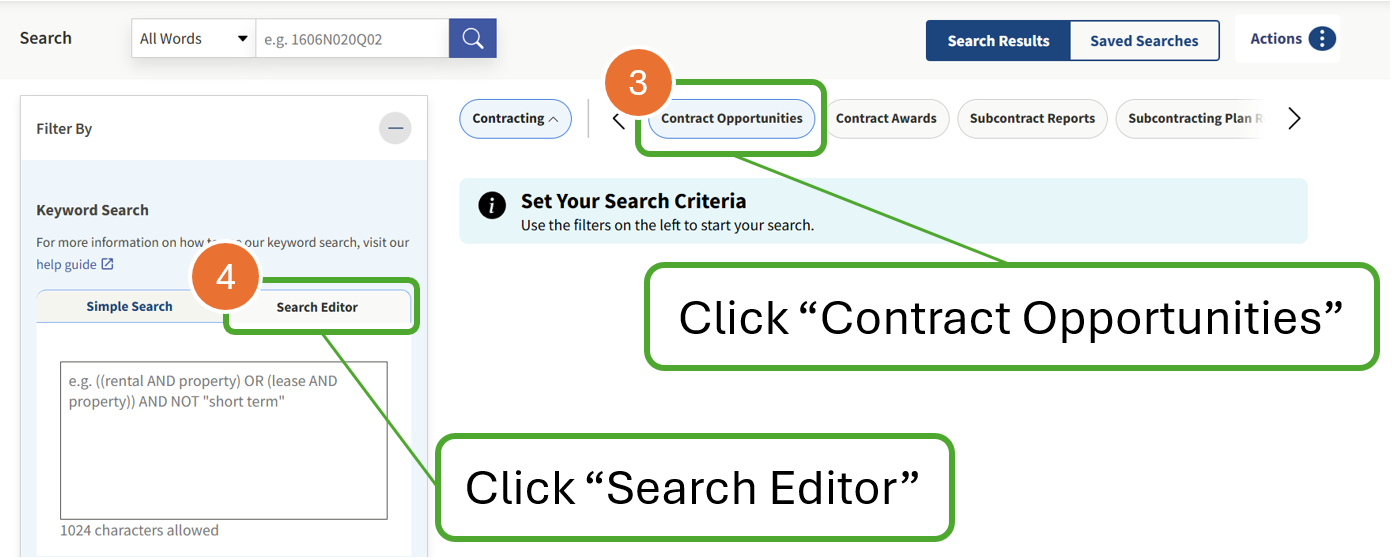
2 Scope to "Contract Opportunities" and open the Search Editor
The "Reverse Search" (Stop Guessing)
Most contractors get stuck because they rely on keywords. Keywords are a trap. They are entirely dependent on whether a Contracting Officer chose the right words for a title that day. If an officer labels a cloud project as "Technical Support," your "Cloud Computing" keyword search will never see it.
The secret is to stop chasing keywords and start looking at your business identity: your NAICS Code. The North American Industry Classification System (NAICS) is how the government decides who is even allowed to play.
If you're not searching by NAICS, you're missing opportunities.
3 Find your Sweet Spot NAICS code by reverse-engineering award notices
Most businesses have five or six NAICS codes, but usually only one or two are the "Sweet Spot" where the money is actually moving. Here is how you find yours.
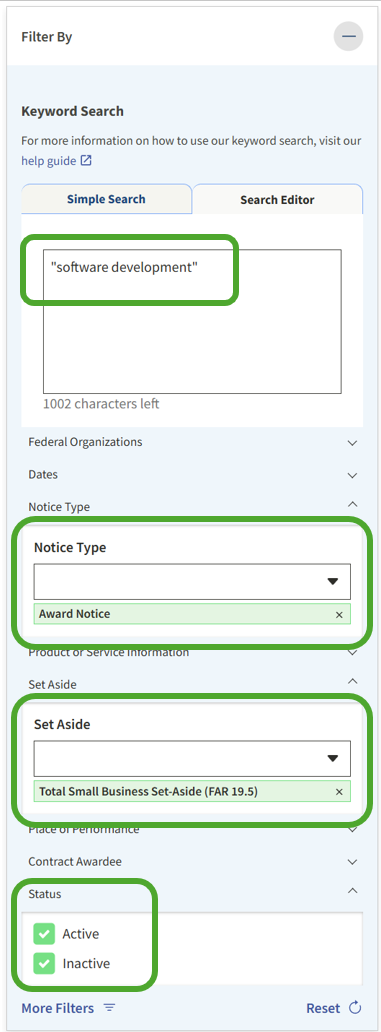
- Search for a project you have already won or one you really want to win.
- Filter your results by "Award Notices" only. This shows you real deals where the government actually spent money.
- Click on the most recent awards and look at the NAICS Code listed on the page.
You might find that while you registered under 541511 (Custom Programming), the contracts you want are actually being awarded under 541512 (Computer Systems Design). Add that higher-volume 541512 NAICS as your primary filter. Now you're looking exactly where the money is flowing.
Pro Tip: Check both "Active" and "Inactive" Status boxes. Sort Results by either "Relevance" or "Updated Date."
4 Confirm your NAICS codes by checking awarded contracts
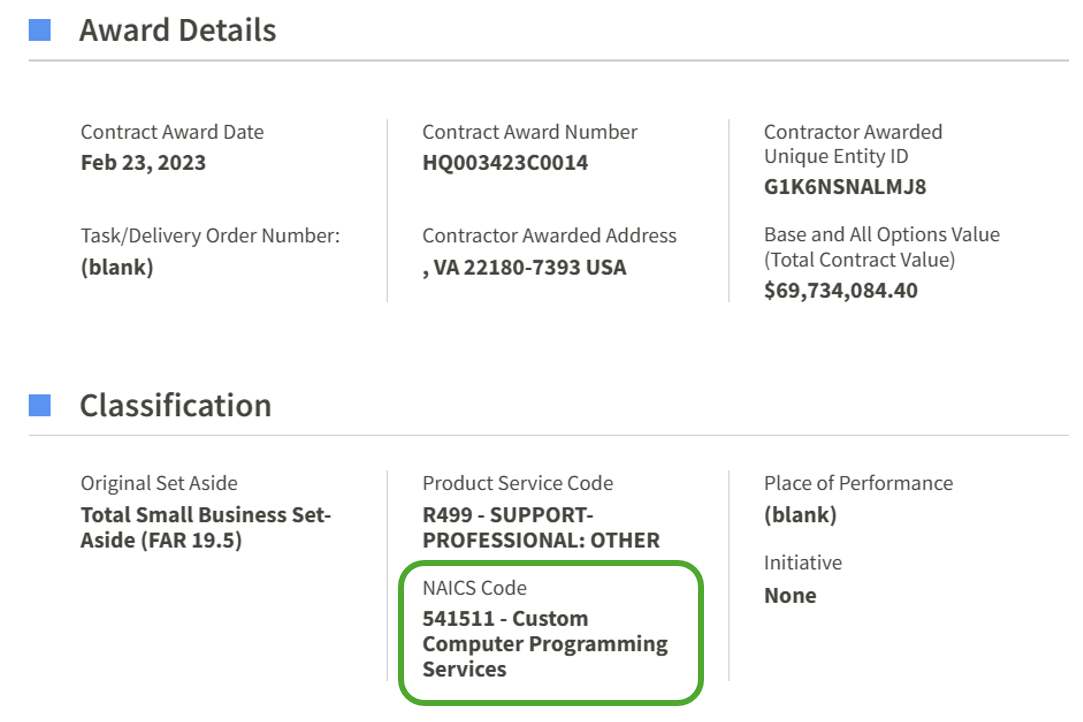
Rank your NAICS codes to prioritize your opportunity searches.
Set the "Tripwire" (The Autopilot Feed)
You don't have time to log in every day and run manual searches. You need to weaponize the notification system that is already built into SAM.gov for free.
5 Build your automated search with these proven filters
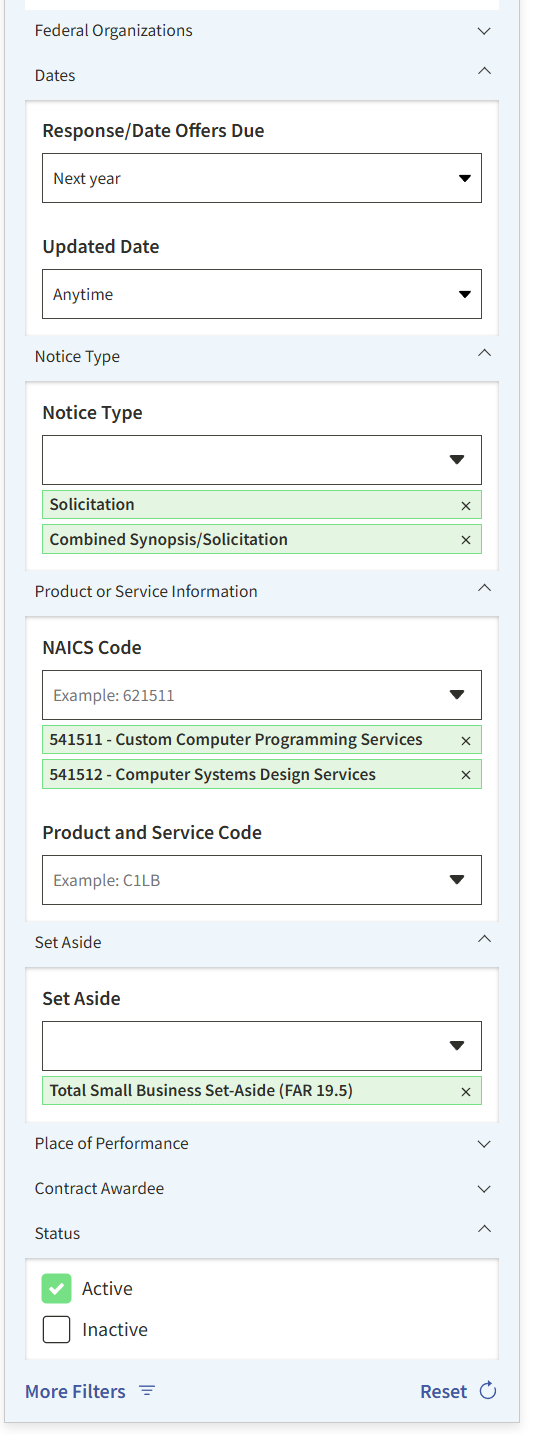
Set these Filters:
Response Date: Pick something into the future to clear out past due opportunities that haven't been made "Inactive" yet.
Notice Type: Skip the busy work and choose real live contracts. Create separate searches for "Sources Sought" opportunities.
NAICS Code: Run your search using the code/s you found in Step 3.
Set-Aside: Check the boxes for your socioeconomic certifications like WOSB, SDVOSB, or HUBZone. This immediately removes the "Full and Open" competitions where you would have to fight billion-dollar companies.
Pro Tip: Sort results by "Relevance" for best results.
Review the search results and you'll notice there are still random opportunities that don't make sense. Let's filter these out using the Search Editor.
Try these Common Filtering Keyword Patterns
These examples demonstrate how the "NOT" operator is profoundly powerful in finetuning your search results.
- "Quotes" keep phrases together in searches: See Example 1
- (Parentheses) group a list of keywords or phrases: See Example 3
- Capitalization matters NOT (vs not)
NOT "license"NOT "cyber security"NOT (licensing OR "license renewal" OR subscription OR SaaS)Tweak your filter until your results look mostly right. You'll save this search next, so you can always tweak it more later.
The Automated Search
6 Save your search

7 Turn on daily email alerts
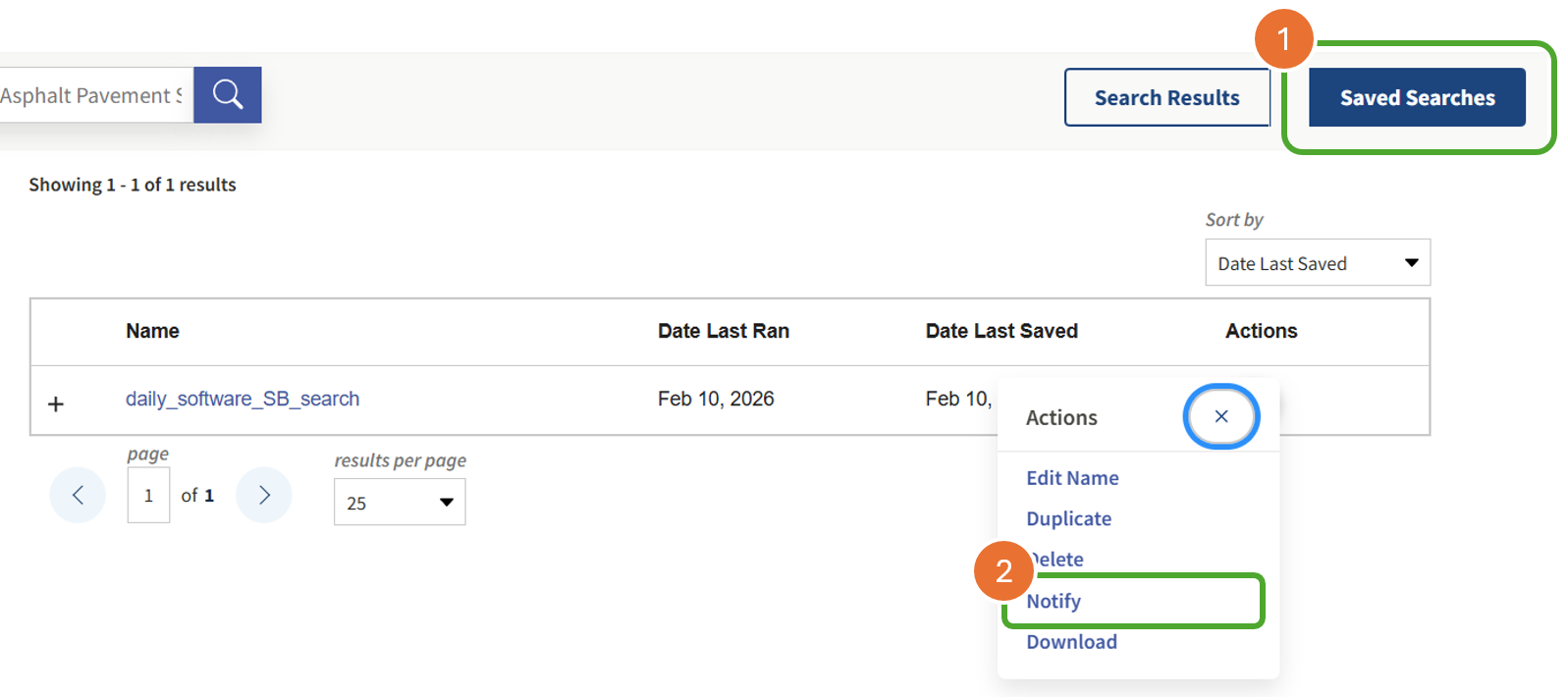
You've automated the SAM.gov search that works for you while you sleep. Every day, SAM.gov will email just your curated opportunities without all the noise.
Best Practice: Prioritized SAM.gov Searches
Sophisticated govcons set up multiple searches with different filters to prioritize their opportunities.
Have only a few minutes today? Check only the email labeled "Priority Search" and save the rest for later.
Now What? Meet The "Big Whammy" (The Decision Gap)
Great, you have an automated feed dropping fresh opportunities into your inbox. Now comes the part that actually kills small businesses.
Tomorrow morning, you will wake up to an email with five leads. But each link contains a massive RFP document package. We are talking zip files full of Statements of Work, Section L instructions, Section M evaluation criteria, and 15 different attachments.
This is the Decision Gap. Most small businesses fail here because they spend hours reading documents only to find a dealbreaker on page 112 (like a requirement for a Top Secret clearance or a specific past performance you do not have). The government can disqualify you before anyone ever reads your Technical Approach.
When your alert fires, start with hard gates before you read the SOW: mandatory RFP requirements and Section L/M disqualifiers, then eligibility triage for set-aside and certification fit.
The Manual Way
You spend 5 hours reading every Section L and M PDF. You miss a hidden requirement and bid anyway. You lose.
Stop Reading RFPs. Start Shredding Them.
This is exactly why we built askaGOAT. We act as the ultimate document qualifier that sits immediately downstream of your SAM.gov feed.
When your feed finds an opportunity, you simply upload the RFP package into our system. We take those hundreds of pages of dense government-speak and turn them into a 1-page Hoofnote.
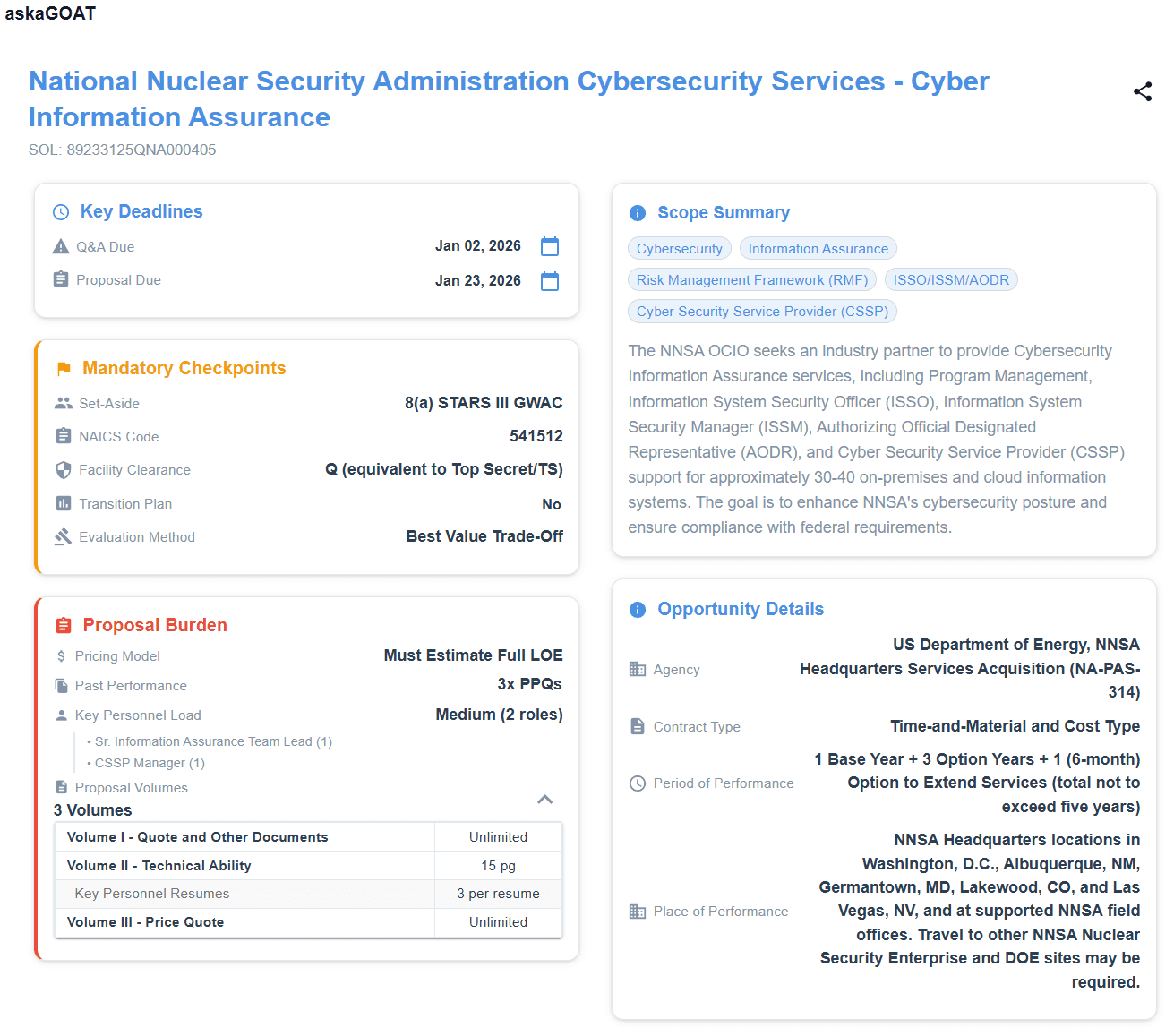
👆 This is a Hoofnote. A 1-page Go/No-Go brief designed for rapid RFP triage. It exposes RFP "Mandatory Checkpoints" and "Proposal Workload" instantly.
The 60-Second "Hoofnote" Workflow:
- The Swipe: Instead of manually reading PDFs, you get an immediate summary of the "Bid Killers."
- Instant Triage: Does the RFP require three past performances of $10M+? Next. Does it match your niche and your team size? Dig in.
- Surface the Vitals: We pull the Facility Clearance, Key Personnel, and Section M Evaluation Criteria to the front so you can decide in seconds, not hours.
The goal of business development is not to be good at searching SAM.gov. The goal is to make Go/No-Go decisions fast enough to win more work. Every hour spent reading a "No-Go" RFP is an hour stolen from a "Must-Win" proposal.
Set up your automated filters today. Then, let askaGOAT shred the document packages so you can focus on the one contract that changes the trajectory of your company.
Your Feed Finds the Leads. We Qualify the Documents.
You have the leads. Now get the answers. Upload your next massive RFP package to askaGOAT and get a "Hoofnote" decision in 60 seconds.
See Your First HoofnoteNo credit card necessary. Full trial access.