
It always starts the same way.
Mastering federal proposal capture is the difference between a growing GovCon firm and a burnt-out team. Most firms focus on the win, but elite federal capture management starts with calculating the 'Proposal Burden' before the first draft begins. It always starts the same way: a promising lead appears, the capabilities align, and the "Win Strategy" seems obvious...until you see the true cost of the bid.
Imagine: a new Solicitation drops on SAM.gov late in the week. You skim the Statement of Work (SOW). It fits your capabilities perfectly. You can already picture the "Win Strategy" slide. You send a note to leadership: "This one looks good."
Then reality shows up.
You open Section L (Instructions) and the mood changes. Multiple volumes. Strict templates. Key Personnel resumes with Letters of Commitment. Custom past performance writeups tied to a detailed matrix. A short fuse on the due date.
You did the math on Contract Value. You did not do the math on the Cost to Bid.
This is where good federal proposal capture strategies fail. Not because the team can't deliver the work, but because they commit before asking the only question that matters:
Is the juice worth the squeeze?
Why Capture Managers Fail: Contract Value is a Terrible Proxy
In Federal Capture Management, price does not equal proposal effort. Anyone who has been through a few fiscal year-ends learns this the hard way.
- Scenario A: A large IDIQ vehicle can be surprisingly easy—sometimes just a "Pass/Fail" technical volume and a price sheet.
- Scenario B: A small agency Task Order can demand a full technical approach, a management plan, a transition strategy, and a stack of resumes.
Dollar value tells you almost nothing about Proposal Burden. Teams get into trouble when they assume "Small Contract \= Small Effort." That assumption quietly destroys B\&P (Bid & Proposal) budgets.
Section L and M: The "Real Cost" of a Solicitation
Before you put a deal in your pipeline, Sections L and M already contain the answer. You just have to extract it.
Section L tells you how to respond. Section M tells you how you will be evaluated. Between the two, you can infer far more about the Level of Effort (LOE) than the SOW ever reveals. In fact, we've argued before why Sections L and M are more important than the SOW when it comes to qualifying a bid.
You are not looking for clever writing prompts. You are looking for three Capture Signals that determine if you should bid.
Capture Signal 1: Volume Count & Structure
How many separate volumes does the government want?
- Standard: Three volumes (Technical, Management/Past Perf, Price).
- Danger Zone: Once you see four or more volumes, effort climbs fast.
Each volume needs structure, ownership, reviews, and compliance checks. For a small team, five volumes on a short timeline isn't ambitious; it is dangerous. Section M often makes this worse by adding scoring weight to standalone volumes, which means more writing, not just more files.
Capture Signal 2: The "Key Personnel" Load
Key Personnel requirements are the quiet budget killer in any GovCon pipeline.
- Manageable: One required resume (usually a PM). Most teams can recycle a current bio, grab a Letter of Commitment, and move on.
- Unmanageable: Multiple Key Personnel.
Once multiple Key Personnel are required, the effort shifts. Now you aren't just writing; you are running a mini-staffing exercise. Recruiting gets pulled in. Technical SMEs have to interview candidates. Availability discussions start for roles that may never be funded.
The Math: Tailoring federal resumes is not "copy-paste." Mapping experience to the PWS, rewriting narratives, and chasing signatures takes 2–4 hours per resume. Five Key Personnel means 20 hours of distraction before you write a single page of technical content.
Capture Signal 3: Past Performance (PPQ vs. CPARS)
Some solicitations let you submit existing narratives. Many do not.
- The Trap: If the RFP requires mapping each project to specific PWS elements, expect 4–6 hours per citation.
- The PPQ Nightmare: When a Past Performance Questionnaire (PPQ) is required, you are not just writing; you are coordinating. You need a government Point of Contact (POC) to sign a form. That signature is on their schedule, not yours.
The Pivot: On the flip side, if the Solicitation accepts CPARS (Contractor Performance Assessment Reporting System) evaluations instead of PPQs, that is a shortcut. It cuts days off your timeline.
A great Capture Manager spots this detail instantly: PPQs mean schedule risk; CPARS mean speed.
The "Napkin Math" for Federal Proposals
You don't need precision to make a Bid/No-Bid decision. You need a defensible "Rough Order of Magnitude" (ROM).
Here is a rule of thumb most experienced teams recognize:
1 Technical Page \= 4 Hours of Effort
(Drafting \+ SME Input \+ Red Team Review \+ Formatting)
Do the Math:
- 30 Pages of Technical \= 120 Hours.
- 5 Resumes \= 20 Hours.
- 3 Past Performances \= 15 Hours.
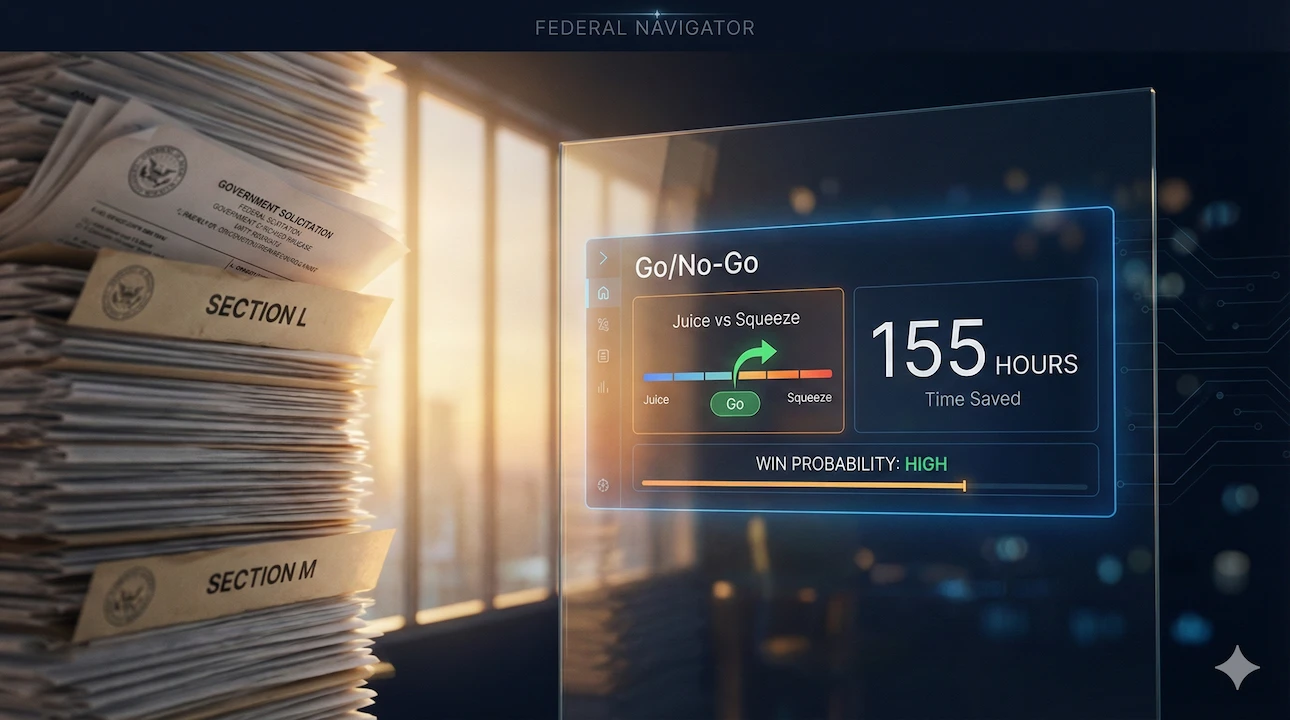
- Total: 155 Hours.
Now ask the real question: Do you have that capacity without breaking your team?
If the answer is no, it is not a character flaw. It is a "No-Bid."
The "Juice vs. Squeeze" Test
- The Juice: Contract Value, Strategic Fit, PWin.
- The Squeeze: Proposal Effort, Disruption, Burnout.
A pursuit only makes sense when the return justifies the squeeze. Why do most teams miss this step? Because Sections L and M are painful to read. They are dense regulatory text. People skim the SOW, get excited, and commit. The burden shows up days later.
Automation: The 60-Second Capture Check
This is where automation earns its keep in modern Capture Management.
askaGOAT is built to answer one question quickly: Is this pursuit worth the effort?
You upload the Solicitation. It scans Sections L and M, understands the submission instructions, and produces a decision-grade proposal ROM:
- Page Counts
- Volume Structure
- Key Personnel Requirements
It doesn't replace judgment. It informs it early.
A Better Pre-Read Strategy
On your next set of SAM.gov leads, before the team gets excited, do this instead:
- Find and filter your opportunities using a proven SAM.gov search strategy.
- Upload the Solicitation to askaGOAT.
- Check the "Proposal Workload" summary in the Hoofnote.
- Run the rough math.
- Decide.
If the answer is no, you just saved real money and real sanity. That is a smart No-Bid.
Estimate Federal Proposal LOE Before You Bid
Run this before writing starts: estimate proposal workload and disqualifier risk from the full RFP package. Upload a federal solicitation to askaGOAT and get a proposal ROM in under 60 seconds.
Start Your Free TrialNo credit card necessary.